
Birds come in all colors, from solid brown to a rainbow of patterns. Yet, purple isn’t a color most people associate with animals. It’s a whimsical hue that’s more commonly seen in fantasy movies than real life. Even so, purple birds exist. Some have a slight hint of purple in their feathers while some purple birds are so vibrant you can’t miss them.

Are There Purple Birds in North America?
Colorful birds seem most common in tropical, international destinations, but that’s not always the case. There are plenty of beautiful birds across North America, some of which have purple feathers. These birds aren’t extremely common, so they’re certainly a stunning sight to see.
The Purple Birds of North America
Purple birds in North America include everything from tiny hummingbirds to slender herons. The amount of purple and the vibrancy vary between each species, but the following birds all have some violet in their coloring.
Costa’s Hummingbird (Tiny Purple Birds)
Female Costa’s hummingbirds look like most hummingbirds, with tiny green and white bodies. Yet, males stand out significantly because of the shimmering violet feathers around their faces. They can flare their marvelous feathers to attract the attention of females.
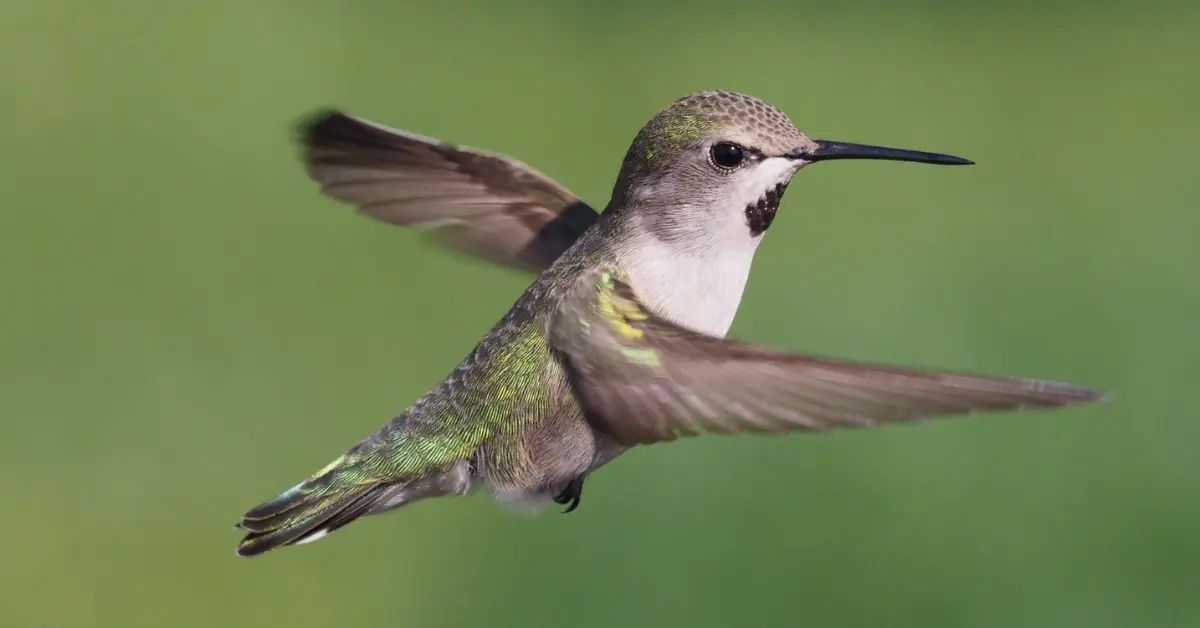
While these purple birds look like imaginary creatures, they live across the southwestern United States and northwestern Mexico. They love the extreme heat of deserts, where they gather nectar from plants like chuparosa and ocotillo.
Violet Sabrewing
From southern Mexico to Panama, you can find violet sabrewings, which is one of the most beautiful species in the world. These birds have iridescent feathers that are primarily purple with hints of blue and green. As they flutter, their feathers shimmer as if they’re glowing.
Violet sabrewings have curved bills that make it easy for them to access flower nectar. Despite being small, this species is large for a hummingbird, measuring approximately 5 to 6 inches long.
Varied Bunting
Like many bird species, female varied buntings appear solid brown. Then, the males look like someone splattering paint all over their feathers. The male coloring includes a mix of purple, blue, and red spots. Even though they’re easy to spot in daylight, their bold colors seemingly disappear when they hide in the shadows.
You’ll find these purple birds across most of Mexico with small numbers entering the southern United States and northern Guatemala. They lay both green and blue eggs, which is a rare trait for songbirds.
Lucifer Sheartail (Birds with Purple Throat)
Lucifer sheartails resemble Costa’s hummingbirds, but the males have shimmering violet feathers across their throats instead of their faces. They live across Mexico, sometimes entering areas of the southern United States.
These purple-throated birds stick to dry, scrubby habitats. Like other hummingbirds, they hover over plants to collect nectar. However, they sometimes feed on agaves that are too small to pick up pollen, causing them to eat without pollinating the plants in return.
Purple Gallinule
Purple gallinules are swamphens found from southeastern United States through South America. Despite their name, they’re much more than just purple. They have a blue and violet body with green wings, yellow legs, and a red and yellow bill. Young birds appear mostly brown, and they develop vibrant colors as they age.
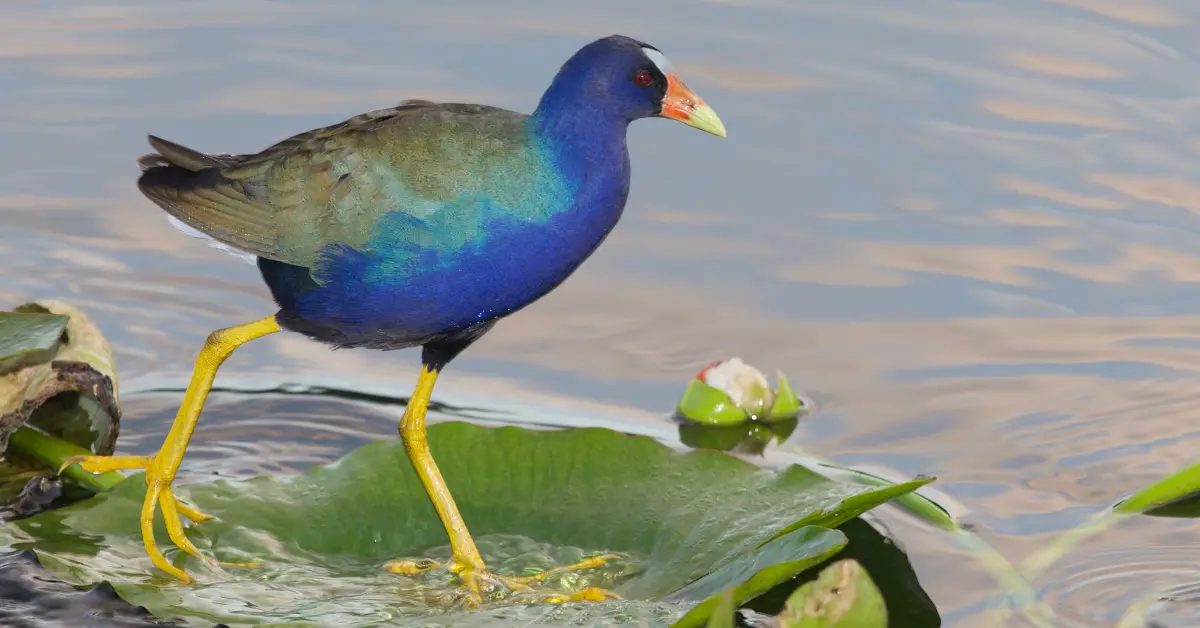
These purple birds are excellent fliers, traveling long distances in search of food. They occasionally appear outside their typical range, including Iceland, Switzerland, South Africa, and the Galápagos. This occurs when food and water are scarce in their typical region.
Gray-Headed Swamphen (Invasive Purple Birds)
These colorful swamphens originate in southern Asia, but a small population appeared in Florida in the 1990s after escaping from captivity. They spread across the southeastern United States, where thousands of them now inhabit swamps and marshes.
Gray-headed swamphens have beautiful blue and purple bodies with orange legs, red bills, and gray heads. They build their nests out of floating vegetation. Groups of females often share one nest that keeps their eggs well-hidden.
Little Blue Heron (Pale Purple Birds)
While the name indicates blue plumage, little blue herons typically have more of a purple tint instead. Juveniles have pure white feathers that become gray in adulthood. The head and neck of this species appear as a toned-down purple.
Little blue herons live from the eastern United States through northern South America. They wade in shallow waters in search of fish and amphibians. Since young little blue herons resemble snowy egrets, the two birds often form mixed-species flocks.
Purple Martin
The name purple martin is a little deceiving. While these black birds sometimes have a purple tint to them, their plumage often appears more indigo or blue. They have a wide range, stretching from southern Canada all the way to central South America.
Purple martins typically nest in woodpecker holes and other tree cavities, however, many people build nest boxes as an alternative nesting option. These purple birds spend most of their time in flight. They always eat and drink in the air by capturing prey in mid-flight and skimming bodies of water for hydration.
Violet-Green Swallow (Birds with Purple Wings)
Violet-green swallows have white chests, green backs, and purple wing tips. Their coloring often looks dark at first glance, but when the sunlight hits their feathers, their true colors shine. They have a wide range across western North America, breeding from Alaska to northern Mexico and traveling down to Central America outside the breeding season.
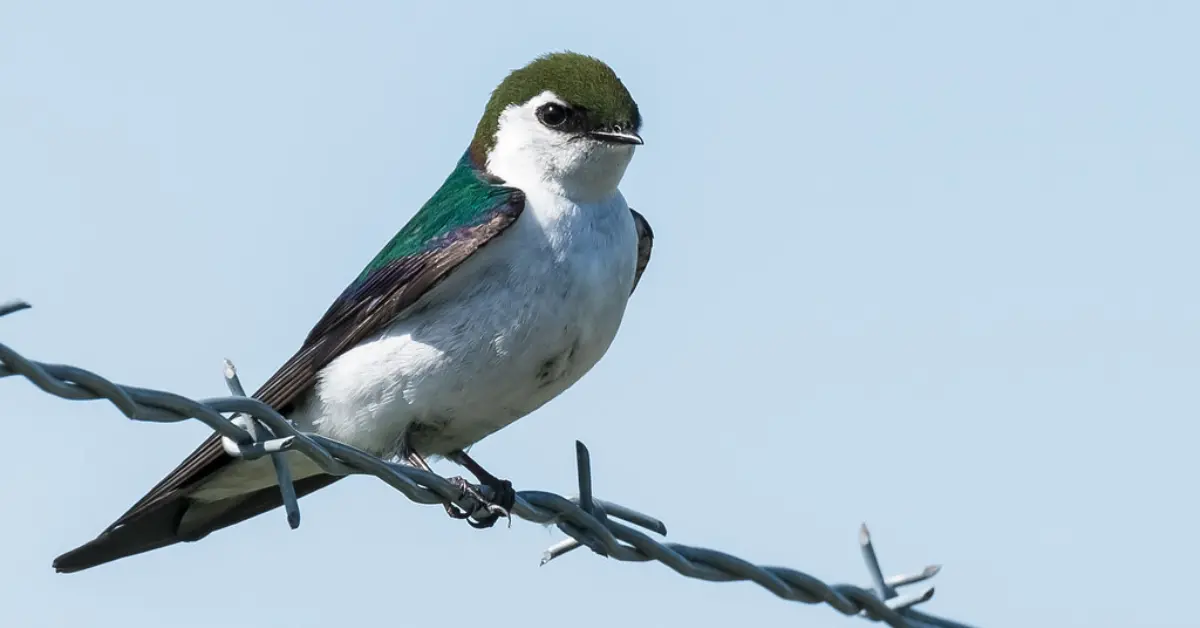
These birds can fly extremely fast for a bird of their size. According to records, they can fly up to 28 miles per hour, which is similar to the peregrine falcon, the fastest bird of prey, which flies 25 to 35 miles per hour.
European Starling (Purple-Throated Birds)
European starlings aren’t known for being purple, but among their dark gray feathers, they have a purple tint around their necks. When the sun hits their feathers right, you may also see glimpses of blue and green in their plumage.
Even though European starlings are native to Europe, Asia, and North Africa, they’re now common across all of North America too. They’re considered an invasive species in their new range because they compete with native birds.
Rock Pigeon (Birds with Shimmering Purple Necks)
Like European starlings, rock pigeons aren’t iconic purple birds, but they do have a hint of purple in their coloring. They have mostly gray bodies, but the iridescent feathers around their necks are green and purple.
Rock pigeons don’t shy away from humans. They most commonly appear in cities, where they feed on scraps from humans. While they’re native to Europe, North Africa, and parts of Asia, they’ve existed in North America since the early 1600s and quickly spread across all of North and South America.
Purple Finch (Reddish-Purple Birds)
With a name like purple finch, you’d expect these birds to be at the top of the list. However, their purple feathers often give off more of a reddish hue. Females are mostly brown and white while males have purple/red feathers on their head and chest.
These purple birds prefer moist, cool areas across Canada and the United States. They’re often found in evergreen forests, where they use their large bills to crack open seeds. Their bills also help them collect seeds from inside fruits.
Great-Tailed Grackle
Male great-tailed grackles have sleek black feathers with hints of purple and blue, especially when the light hits them just right. The males also have large tail feathers that they can spread out to attract females. The females are about half the size of males with warm brown feathers.
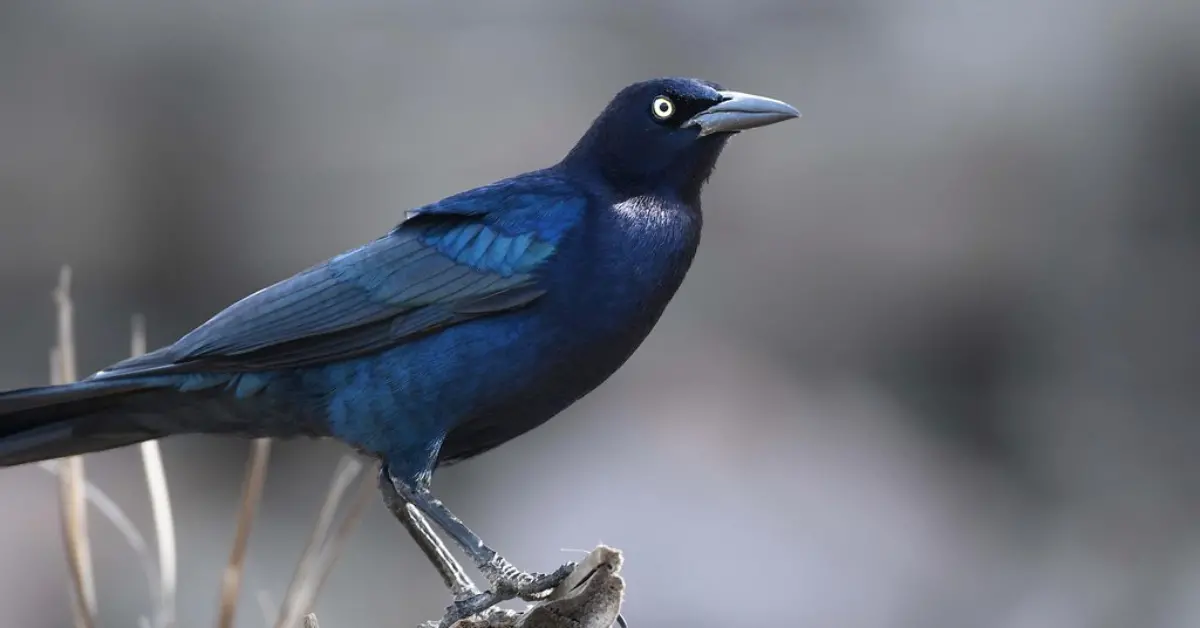
Great-tailed grackles live from the western United States to the tip of South America, and they typically stay in the same area year-round. They often form enormous flocks with thousands of individuals. Those flocks roost together in large trees.
Violet-Crowned Hummingbird
These small birds have white bellies and brown wings, but their most notable feature is their purple crests. They primarily live in western Mexico, where they stick to the middle elevations of canyons. They feed on both nectar and small insects using their long, narrow bills.
As a larger hummingbird species, researchers have observed violet-crowned hummingbirds chasing away smaller species from food sources. If there are larger hummingbirds nearby, violet-crowned hummingbirds rapidly zip past nectar sources, gathering a little from each one before they’re chased away.
Brewer’s Blackbird (Birds with a Purple Tint)
Brewer’s blackbirds are mostly glossy black with white eyes (although the females are brown). Yet, their feathers can appear green, blue, and violet when you look at them from different angles.
They’re common across most of North America, often gathering in towns and open areas. They’re social birds, so they may form nest colonies of up to 100 birds. Their eggs often vary in color, typically appearing green or white with different patterns of brown speckles.
You May Cross Paths with Purple Birds in North America
It’s possible to see purple birds in North America, which surprises many people. These birds might not be solid purple from beak to tail, but there are several bird species with some violet feathers. This color doesn’t appear in nature often, so if you spot one of these gorgeous animals, spend some time admiring its beauty.